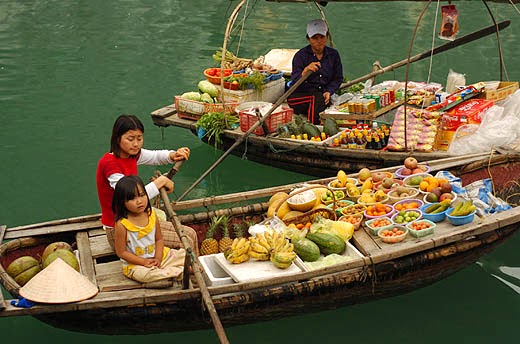
Vietnam fishing village named among world’s top 16 coastal towns

3:53 PM |
Vietnam fishing village A fishing village in northern Vietnam has been picked among the top 16 best coastal towns in the world by US travel magazine Travel + Leisure, the Vietnamese Ministry of Culture, Sports, and Tourism said Thursday on its website.

Cua Van fishing village, located in the northern province of Quang Ninh, was ranked ninth out of the 16 most beautiful coastal towns in the world, followed by Ilulissat, a town in the Qaasuitsup municipality of western Greenland; Oia, a small town in Greece; and Paternoster, one of the oldest fishing villages on the West Coast of South Africa.

“Located in Vietnam’s dramatic Ha Long Bay, with lush mountains as a backdrop, this little village is completely composed of floating homes,” Travel + Leisure said about the Vietnamese town.

“About 700 people (traditionally fishermen) live in anchored houseboats, with kids attending a floating school. Cua Van has become a popular tourist attraction, as visitors want to see this unusual way of life for themselves,” it added.

Polperro, a village and fishing harbor on the southeast Cornwall coast in South West England, topped Travel + Leisure’s list.

Cua Van fishing village is situated in Ha Long City – Quang Ninh’s capital – and is surrounded by mountains and a verdant landscape. The residents' main income source is fishing, and they live in floating houses.

Travel + Leisure is a travel magazine based in New York City and specializes in leisure travel. It often features articles written by novelists, poets, artists, designers, and non-travel journalists.


Quang Ninh opens tours to new tourism destinations

4:04 PM |
QUANG NINH (VNS) — Quang Ninh Province has listed three new tours and 12 tourist destinations in the city of Mong Cai.
The tours are around the city centre and from the centre to Tra Co beach and to Po Hen Memorial Monument.
The city centre includes the Mong Cai border gate with China, Bac Luan bridge, National Landmark No 1369, Xa Tac Temple, Ka Long Bridge, and several markets and trade centres.
The second tour takes in the Tra Co – Binh Ngoc T-junction, Tra Co Temple, Tra Co Church, Xuan Lan Pagoda, Nam Tho Pagoda, Vinh Thuan Golf, and the Sa Vy border information complex.
The third passes through the Mong Cai International Border Gate, Bac Luan bridge, National Landmark No1369, Po Hen Memorial Monument, and markets and trade centres. All these places have been named new tourism destination.

Keep Halong Bay Beautiful

2:29 PM |
While traveling around Halong Bay, there are many things for tourists and residents to see and enjoy. With sightseeing, boat tours, cave exploration, and shopping at the markets, there are numerous options to attract travelers. While absorbing the beauty of Vietnam, be aware that not everyone is as focused on protecting this UNESCO World Heritage Site.
In fact, one of the greatest threats to the beauty of Halong Bay is from the passing tourists. Here are some things to avoid and be aware of while visiting Halong Bay.
Buy Smart
The first risk to the area is through common souvenir hunters. These may be from residents who collect protected items for sale in the markets, or from travelers who seek to find their own souvenirs. Some marketplaces may attempt to sell unusual relics from the area. Avoid purchasing from shops which are selling coral fragments, unusual shells or unique stones, as these may have been illegally removed from protected areas such as the local caves. Many of these items are converted into rings, key chains, desk weights and ashtrays which are offered for sale to unsuspecting travelers. Buying these items creates a black market and will only lead to the further vandalism of Halong Bay. Please help to discourage these traders by refusing to buy these items.
Admire the Coral from a Distance
Coral mining is one of the most common forms of damage caused by tourists. Coral grows at an extremely slow rate, and these living organisms develop a hard outer shell, which create reefs over thousands of years. Since coral grows at a varying rate that depends on ocean temperatures and water conditions, there is no guide to know how long it will take to recover from any damage. Travelers need to be aware that with the number of tourists that pass through Halong Bay each year, there will be no coral left if even a fraction of those people each collect a coral fragment. Many signs are posted to discourage and remind tourists of this regulation. Admire coral from a distance, but please refrain from taking any home as a souvenir.
Look, Don’t Touch
Rock formations in the bay are subject to erosion, and many of these karst formations seem to be balancing precariously already. For these reasons,rock chipping is discouraged. The vandalism of the caves results in damages that cannot be restored for hundreds of years. Yet, each year stalactites and stalagmites are broken off within the numerous caves around Halong Bay. When you tour the beautiful caves in the region, feel free to take pictures and admire the natural art. However, avoid touching or breaking the formations, which causes permanent damage to the caves.
As the coastal home to numerous forms of fish, crustaceans, and mollusks, as well as the tropical environment for an entire ecosystem, there are literally thousands of species that depend on Halong Bay. Some of these plants and animals are particularly rare and unique to the area. While traveling this beautiful tropical paradise, be sure help to keep the bay beautiful for all of the future generations to enjoy.

Shopping in Halong Bay

2:22 PM |
Shopping in and around Halong Bay can be an exciting and worthwhile travel experience. While enjoying the limestone karst formations, the beauty of the hidden caves, and the luxurious beaches, be sure to stop and purchase some souvenirs to remind you of the trip once you return home.
The Night Market at Bai Chay
When visiting Halong Bay, you should make time to visit Bai Chay’s night market. The night market is a series of open air stalls, much like other traditional marketplaces. These stalls sell traditional Vietnamese souvenirs, such as the conical hats commonly seen worn by the local women, which are called ‘non la’. Also available are dolls which are dressed in the women’s long dress, which is called the ‘Ao dai’. Other frequent souvenirs include lacquered chopsticks, wooden chopstick holders, lacquered dishes, ceramic tea sets, t-shirts, dresses, rich silk fabric and the famous wooden statues of Vietnamese ladies. Most shops will also offer snacks of chips and drinks, as well.
Since prices are often marked significantly higher than their fair market values, you should attempt to negotiate a lower price. If the shopkeeper will not lower his price, then move on to the next stall where another vendor may be more willing to compromise. For a more adventurous experience, trading can be done between different market shops.
Floating Shops
There are also boats which act as floating shops. These can be found nearby cruise ships, wharf and in makeshift areas where vendors lash their boats together, creating a floating market. These waterborne convenience stores will carry much of the traditional fare, as well as fresh seafood. It is common for these smaller floating shops to tie on to a larger junk and offer their fresh lobster, fish, shellfish, prawns, and other fresh locally caught seafood. There are many opportunities to visit any one of the tourist junks in a bay that is full of them. While it may cost more to buy traditional items from a floating shop, the unique experience is often worth the extra cost for tourists.
other Nearby Markets
While visiting Halong Bay, be sure to visit the nearby Halong market. Sitting in the center of Halong City, this market is a source for high quality and inexpensive local seafood, including the delicious hot squid ball. The Mong Cai market is popular for sightseeing as well as purchasing fabrics, clothes, fruit and high tech products. Another available market is near Hang Sung Sot, which is within easy reach while visiting the Amazing Caves. The most unique market near Halong Bay is the Binh Lieu market, which is in the highlands of the Quan Ninh province. The traders there will carry different locally grown agricultural products such as rice, corn, cinnamon oil, anise, and honey.
A visit to Halong Bay is not complete until you enjoy the many markets in the area. The experience will help you to treasure your time in the area even more.

Halong Bay becomes one of The New 7 Wonders of nature

2:16 PM |
Halong Bay’s elevation Friday as one of the ‘New 7 Wonders of Nature’ is revving the engines of boats across this UNESCO World Heritage Site as operators anticipate a new wave of interest in the wake of the Nov. 11 announcement.
The dramatic bay, studded with nearly 2,000 limestone karst islands over a 1,500-square kilometer expanse, won a coveted spot on the list, besting the likes of the Grand Canyon, the Maldives and Mt. Kilimanjaro.
“Halong Bay is the unimpeachable choice,” said Kurt Walter, group general manager of Apple Tree Group Hospitality, which includes Emeraude Classic Cruises on Halong Bay. “For so many years, Halong Bay was shrouded by the veil of war and strife and really, it’s only been since the 1990s that the world has started waking up to the bay’s magnificence. And now that it has, we expect to see a great deal of interest in seeing the bay first hand.”
News sources inside Vietnam state that Halong Bay expected to see 5.4 million visitors to the bay in 2011, including 2.5 million foreign travelers. Designated a World Heritage Site by UNESCO in 1994, and then again in 2000 for its geological value, the bay is Vietnam’s top tourist attraction.
“The bay’s already popular, but that’s among a certain set of travelers, people interested in cultural pursuits and really going beyond the well-trodden paths you find in places like Thailand and Bali,” said Adam Sitkoff, executive director of the American Chamber of Commerce in Vietnam. “But now with this new recognition, it’s more likely that Halong Bay will move more decisively into the main currents of travelers to Southeast Asia.”
Halong Bay’s identification as one of the New 7 Wonders of Nature is “provisional,” according to the project’s oragnizer, New7Wonders. The organizers intend to formally announce the final slate at an inaugural ceremony in early 2012.
Millions cast votes for their favorite wonders, beginning in 2007. There was never any doubt that the final seven would, in part, be the winners of a popularity contest. Indeed, tourism bureaus and hotels from all over actively campaigned on their favorite’s behalf.
The Caravelle Hotel in Ho Chi Minh City, for example, campaigned for Halong Bay from its employees’ email signatures.
“What’s good for Halong Bay is good for us in Ho Chi Minh City,” said John Gardner, general manager of the hotel. “As a primary gateway to all of Vietnam, we’ve got a vested interest in the popularity of sites all over Vietnam.”
While no one’s yet reckoned an estimate of the boost in traffic to Halong Bay as a result of the recognition, many expect to see measurable gains, especially among repeat visitors.
“Unlike some destinations, Halong Bay is not one that you merely tick off a bucket list,” said Kurt Walter. “I’ve been out to the bay overnight every week for the past seven years, but the bay does not get old. You never get used to it.

Ha Long Bay recognized as a natural wonder of the world

2:07 PM |
VietNamNet Bridge – Chairman of the New7Wonders on April 27 presented the symbol of new world natural wonder to Minister of Culture, Sports and Tourism Hoang Tuan Anh and Chairman of Quang Ninh province at a ceremony in Hanoi.
The ceremony was held at the My Dinh National Stadium, where the miniature of Ha Long Bay set up on the stage.
Speaking at the ceremony, Minister Hoang Tuan Anh expressed gratitude to international friends who voted for Ha Long Bay as a new natural wonder of the world. He said that this is a chance to introduce the beauty of Vietnam to the world and to turn Ha Long Bay into an attractive destination of Vietnam.
Chairman of the New7Wonders, Mr. Bernard Weber, said that the poll of the new seven natural wonders of the world was a lively and fair competition. Vietnam’s Ha Long Bay has won the title and become part of the global memories.
In the light of fireworks, Mr. Weber announced that Ha Long Bay is a new natural wonder of the world and presented the bronze symbol of 1.3m long, 1.1m wide to Minister Hoang Tuan Anh and Quang Ninh province’s Chair Nguyen Van Doc.
Earlier, the New7Wonders brought two symbols to Vietnam, which were manufactured manually in Switzerland, which are placed in Hanoi and Ha Long city.
Speaking at the ceremony, Deputy PM Nguyen Thien Nhan said that the title is the pride of Vietnamese people. However, it requires each Vietnamese to be responsible for preserving Ha Long Bay.
Over 3,000 people participated in the art show to welcome the new title of Ha Long Bay.

Ha Long Carnival promotes ethnic cultures

2:02 PM |
The rich culture of ethnic communities in the northern coastal province of Quang Ninh and the northeastern region was highlighted at the spectacular Carnival Ha Long 2012 held on May 1.
An event to mark the province’s Ha Long Bay being listed as one of the New Seven Wonders of Nature, the carnival was the biggest ever since first held five years ago.
Thousands of people, including many foreign tourists, enjoyed performances featuring the hospitality and beauty of local people and land.
Several famous artists, including People’s Artist Quang Tho and pop stars Ho Quynh Huong and Ngoc Anh, took part in the event.
In addition, performances by art troupes from the Republic of Korea, China, Laos and the Philippines create extra cultural diversity at the event.
A vivid parade gathering thousands of ethnic people living in the province took place on the city’s main street alongside the beach.
Unlike other previous carnivals, where most of the performers were professional artists, this year’s event gathered more than 3,000 performers from ethnic San Chay, San Diu, Tay and Dao groups.
The tourists also had a chance to learn about the distinctive cultural identities of different ethnic groups when several traditional festivals and customs were presented.
They wallowed in the festive atmosphere of a traditional wrestling competition of Quang Yen District, or a rice-planting kick-off ritual from women of the Ha Nam Island in Yen Hung District.
While the San Diu group living in Van Don replicated a traditional wedding, the Dao, Hang Bo and San Chay groups presented folk dances.
The carnival became more beautiful with a spectacular fireworks display presented by French artists.
The parade was also joined by a group of 300 local Buddhists, aiming to promote the spiritual culture of the province, considered as a cradle of Vietnamese Buddhism. The 1,068m above sea level Yen Tu Mountain in the province is the place where King Tran Nhan Tong in the 13th century founded the Truc Lam Zen School.
The site attracts thousands of pilgrims every year, contributing significantly to the province’s socio-economic development.
Minister of Culture, Sports and Tourism Hoang Tuan Anh, President of the New7Wonders Foundation Bernard Weber and representatives of other New Seven Wonders of Nature participated in the event.
 

The ten best destinations in Vietnam

5:26 PM |
VietNamNet Bridge – globalgrasshopper, a popular site for international tourists, has listed the top ten must-see destinations in Vietnam.   
1.Son Tra peninsula

Son Tra Peninsula, about 10km from the center of Da Nang City to the north-east, is a special gift of the god to Da nang. It is an ideal place for tourists in Vietnam travel to the city, to get away for the day and enjoy the real feeling of a different Vietnam.
Son Tra looks like a mushroom of which the cap is Son Tra Mountain and stalk is a beautiful sandy beach that affords an ideal area for bathing, swimming, playing sports and fishing.
Son Tra acts as a giant screen protecting Da Nang from storms and cyclones coming from the sea. Son Tra is put under the national protected forest regulation since it is a natural preservation area.
The peninsula is famous for its plentiful plants and fauna as well as the attractive scenery. It is said that fairies used to come here for singing, dancing and playing chess so Son Tra is also called Tien Sa. On this mountain, there still remain more than 30km² of natural forests, nearly 300 types of plants and several hundred kinds of fauna, including rare animal. From the top of the mountain, you can see the overall view of Da Nang City, Marble Mountains, Ba Na – Mount Chua.
Suoi Da (Stone Stream) lies by the side of the foot of the mountain, fine sandy surfaces run round the peninsula, several breaks of waves are running steadily up and down and washing up on the stones heaped up around the seaside. All are attractive spots for tourists. It is so majestic and it is so romantic, it is so wide and it is really beautiful.
2. Royal tombs of Nguyen dynasty

The Nguyen Dynasty (1802-1945) is the last of the Vietnamese dynasties. In total, there were 13 emperors, only seven of which had tombs however: Gia Long, Minh Mang, Thieu Tri, Tu Duc, Duc Duc, Dong Khanh and Khai Dinh.
The seven imperial tombs are located in a hilly region southwest of the Citadel. The tombs of Minh Mang, Tu Duc, Dong Khanh and Khai Dinh belong to the major touristic destinations in Hue.
Each of the tombs was constructed during the reign of the emperor it was named after. All the tombs are equipped with statues and monuments in perfect Feng Shui harmony to create a natural setting, in the architecture of which the respective emperor's philosophical tendencies are often reflected.
The general elements incorporated in all the tombs are: walls, triple gate (Tam Quan Gate), Salutation Court, Stele House, temples, lakes and ponds, pavilions, gardens, and finally the tomb.
King Khai Dinh tomb is considered the most beautiful.
3. Phu Quoc Island

Phu Quoc is part of the southern province of Kien Giang province. The island is 50 km long (from north to south) and 25 km wide (from east to west at its widest part).
Surrounded by more than 40 km of white beaches decorated with coconut palms, Phu Quoc is Vietnam’s largest island. Its western coastline is sparsely populated while the interior is largely covered with jungle and mainly deserted.
A stay on Phu Quoc Island would not be complete without visiting one of the factories producing nuoc mam (fish sauce), one of the most popular ingredients of the Vietnamese cooking as well as one of the pearl farms with panels describing the formation of pearls and shops selling pearl jewelry.
The island has a unique species of dogs, the Phu Quoc ridgeback, which has a ridge of hair that runs along its back in the opposite direction to the rest of the coat. Much of this island’s nature is still protected. Around 70 percent of the island, an area of 31,422 hectares, became a national park in 2001. The rainy season on Phu Quoc is from July to November and the peak season for tourism is midwinter, when the sky is blue and the sea is calm.
4. The Mekong Delta

The Mekong Delta is the region in southwestern Vietnam where the Mekong River approaches and empties into the sea through a network of distributaries. The Mekong delta region encompasses a large portion of southwestern Vietnam of 39,000 square kilometers. The size of the area covered by water depends on the season.
The Mekong Delta has recently been dubbed as a 'biological treasure trove.' Over 10,000 new species have been discovered in previously unexplored areas of Mekong Delta.
The Mekong Delta, as a region, lies immediately to the west of Ho Chi Minh City, roughly forming a triangle stretching from My Tho in the east to Chau Doc and Ha Tien in the northwest, down to Ca Mau and the East Sea at the southernmost tip of Vietnam.
The Mekong Delta region of Vietnam displays a variety of physical landscapes, ranging from mountains and highlands to the north and west to broad, flat flood plains in the south. This diversity of terrain was largely the product of tectonic uplift and folding brought about by the collision of the Indian and Eurasian tectonic plates about 50 million years ago. The soil of the lower Delta consists mainly of sediment from the Mekong and its tributaries, deposited over thousands of years as the river changed its course due to the flatness of the low-lying terrain.
Coming to the delta, visitors will discover the daily life of local people and diverse landscapes.
5. Tram Ton Pass (Heaven Gate)

Tram Ton Pass is Vietnam’s highest mountain pass. On a clear day, the views are spectacular. Don’t be deterred by mist in Sapa. Conditions on the pass are frequently different to those in town. The temperature can also rise quite a bit on the pass as you break away from the cooler air of Sapa.  
Thach Bac or Silver waterfall is a compulsory stop for local tour groups and can be pretty busy. The falls are beautiful but probably only warrant a visit if time permits and in conjunction with a visit to Tram Ton Pass 3kms further along the road.
6. Phong Nha-Ke Bang National Park

Phong Nha-Ke Bang is a national park and UNESCO World Heritage Site in the central province of Quang Binh, about 500 km south of Hanoi.
Phong Nha-Ke Bang National Park is noted for its cave and grotto systems as it is composed of 300 caves and grottos with a total length of about 70 km, of which only 20 have been surveyed by Vietnamese and British scientists; 17 of these are in located in the Phong Nha area and three in the Kẻ Bàng area.
After April 2009, total length of caves and grottoes are 126 km. Before the discovery of the Son Đoong Cave, Phong Nha held several world cave records, as it has the longest underground river, as well as the largest caverns and passageways.
The park derives it name from Phong Nha Cave, containing many fascinating rock formations, and Ke Bang forest. The plateau on which the park is situated is probably one of the finest and most distinctive examples of a complex karst landform in Southeast Asia.
This national park was listed in UNESCO's World Heritage Sites in 2003 for its geological values as defined in its criteria viii. In April 2009, the world's largest cave, was discovered by a team of British cave explorers of British Caving Association.
7. Ha Long Bay

Ha Long Bay is a UNESCO World Heritage Site, and a popular travel destination, located in Quang Ninh province. The bay features thousands of limestone karsts and isles in various sizes and shapes.
Ha Long Bay has an area of around 1,553 km2, including 1,960–2,000 islets, most of which are limestone. The core of the bay has an area of 334 km2 with a high density of 775 islets. The limestone in this bay has gone through 500 million years of formation in different conditions and environments. The evolution of the karst in this bay has taken 20 million years under the impact of the tropical wet climate. The geo-diversity of the environment in the area has created biodiversity, including a tropical evergreen biosystem, oceanic and sea shore biosystem. Ha Long Bay is home to 14 endemic floral species[4] and 60 endemic faunal species.
Historical research surveys have shown the presence of prehistorical human beings in this area tens of thousands years ago. The successive ancient cultures are the Soi Nhụ culture around 18,000–7000 BC, the Cái Bèo culture 7000–5000 BC and the Hạ Long culture 5,000–3,500 years ago. Hạ Long Bay also marked important events in the history of Vietnam with many artifacts found in Bài Thơ Mout, Đầu Gỗ Cave, Bãi Cháy.
In 1994, the core zone of Hạ Long Bay was listed by UNESCO as a World Heritage Site according to criterion vii, and listed for a second time according to criterion viii.
8. One-pillar pagoda

The One Pillar Pagoda is a historic Buddhist temple in Hanoi. It is regarded alongside the Perfume Temple, as one of Vietnam's two most iconic temples.
The temple was built by Emperor Ly Thai Tong, who ruled from 1028 to 1054. According to the court records, the king was childless and dreamt that he met the bodhisattva Avalokiteshvara, who handed him a baby son while seated on a lotus flower. Ly Thai Tong then married a peasant girl that he had met and she bore him a son. The emperor constructed the temple in gratitude for this in 1049, having been told by a monk named Thien Tue to build the temple, by erecting a pillar in the middle of a lotus pond, similar to the one he saw in the dream.
The temple is built of wood on a single stone pillar 1.25 m in diameter, and it is designed to resemble a lotus blossom, which is a Buddhist symbol of purity, since a lotus blossoms in a muddy pond. In 1954, the French Union forces destroyed the pagoda before withdrawing from Vietnam after the First Indochina War, It was rebuilt afterwards.
9. Da Dia Rapids

Da Dia (Stone Plate) Rapids are located in Tuy An District, Phu Yen Province, central Vietnam. With strange rock formations, foamy rapids, a fissure with multi-colored fish and a deep cave, etc. Da Dia Rapids was listed as a National Heritage Site by the Ministry of Culture and Information.
Da Dia Rapids is a baffling and beautiful riddle of nature, and set in stone for all time. It’s like a giant jigsaw, irritatingly made of the same shaped pieces, and forming a solidified structure that has proved more than just a curiosity for thousands.
The stones in Da Dia Rapids are bazan stones of dark black and light yellow. There are large stones of tons and small stones with different shapes such as round, pentagon, and polygon and so on.
In the middle of the rapids, there is a small fissure filled with rain water and sea water. In this fissure, rocks stick out at odd angles. Hence, when travel to this area, visitors can also enjoy the fresh air and refresh after a long drive.
Visiting Da Dia Rapids – you will have chance to learn about many species of marine creatures, especially jam seaweed is a type of kelp which is sticks to the stones, looking like a network and the local use it as a special food.
10. Hue ancient capital

On 11th December 1993, the UNESCO recognized the architectural ensemble of Hue as a World Cultural Heritage. That is the first time a Vietnam's city ever received such a title. The ancient capital of Hue was the capital of the Nguyen Dynasty (1802-1945), the final feudal regime of Vietnam. Situated 638 km to the south of Hanoi, only with 6777 ha in area and 280,000 in population, this historical ancient capital has become one cultural and tourism center of Vietnam and the world. 
The most amazing thing about Hue is the blend of royal-folk architecture and romantic nature. This romance is all evident in the beauty of the Huong River, Ngu Mountain, chanties and folklore songs, ancient citadels, palaces, temples, pagodas, ancient garden houses, special cuisine only found in Hue, court music and dancing, Hue chanties on the River Huong and especially in the souls of the people here.
Beautiful nature, ancient architecture, and elegant people are combined together to make Hue a heaven of poems, music and paintings, and a World Heritage that serves as an everlasting inspiration for generations of artists.

Global community focuses on Ha Long Bay

5:10 PM |
Global community focuses on Ha Long Bay    An international seminar on Ha Long Bay will be held in Ha Long City in Quang Ninh province on July 24.   
The Vietnam National Administration of Tourism (VNAT) held a press conference in Hanoi on July 17 to announce the event, which aims to seek out measures to preserve and promote the values of the World Heritage Site to develop tourism in a sustainable manner.
VNAT General Director Nguyen Van Tuan said ever since it was recognised as a world natural heritage 18 years ago, Ha Long Bay has become one of the country’s most visited tourist spots.
The bay was also recently voted as one of the seven new wonders of the world, he added.
Tuan said the VNAT and Quang Ninh are working together on advertising campaigns and a series of promotions to spotlight Ha Long Bay and make it one of the leading tourist destinations on earth.
According to the organising board, the seminar will focus on defining the important role of Ha Long Bay and its position in the country’s tourist industry as well as current development trends, opportunities and challenges.
They will also put forward proposals to ensure the site is preserved for future generations and examine existing management procedures.
To date, the organising board has received 20 reports from regional and international academics, researchers and business managers.
In 2011, Ha Long Bay welcomed over 5.5 million tourists, half of them from overseas.
 

WiFi Free in Ha Long Bay wonder

5:07 PM |
A lot of projects investing on Ha Long bay's infra-structure have been launched and completed. It creates favorable conditions for Ha Long Bay to develop its tourism and attracts more tourists.
Among the plethora of projects, Wifi Internet coverage in Ha Long bay contributes to the infra-structure completion in the city possessing the world's natural heritage and wonder.Under the Memorandum of Understanding (MOU) of the provincial people's committee and Vietnam Posts and Telecommunications Groups on developing the WiFi Internet Access System in Quang Ninh, the cooperation objectives include: Serving the internet access demand for investors, visitors and provincial people in the central areas; broadcasting the information on social economic and cultural development of Quang Ninh province; offering favorable business conditions; supplying fast and convenient services; attracting domestic and foreign investment; Contributing to the tourism, commercial, industrial and marine economic growth; Expanding the information services of the Posts and Telecommunication Groups in Quang Ninh.
Based on this MOU, the provincial people's committee directed the Department of Information and Communication to plan the installation of WiFi Internet in the Ha Long city. It is expected that 44 areas to be supported WiFi internet so that the people and visitors can freely use the service before April 20,2012 (10 days before the Ha Long - Quang Ninh Tourism Week 2012). The installation stations are mostly located along QL18A route running through Ha Long city (From Ha Tu Post Office to Ha Long night market in Bay Chay). These locations are crowded with residents and visitors.
Local people and visitors can freely access to some basic information pages. If they want to enter some recreational services or download large capacity information, they must pay for the services. However, the people can access to WiFi internet everywhere in Ha Long city. Those who want to work outside, not at their home or offices can easily access to internet.
 Ha Long city is looking forward to a modern tourism city, the development of an information and communication system is necessary, said Mr. Nguyen Minh Hong, Director of Department of Information and Communication.

Life in Vung Vieng Fishing Village - Halong Bay

5:02 PM |

Vung Vieng fishing village is located in the northeast of Ha Long Bay and is home to more than 62 households. Vung Vieng has dramatically changed compared to previous years due to support policies and local government aid. People’s living conditions have improved through tourism and Vung Vieng promises to become one of the bay’s most popular tourist destinations.
Official Tran Hung Viet from the Marine Cultural Preservation Center of the Management Board of Ha Long Bay talked about Vong Vieng fishing village with attraction and unique buildings, especially houseboat communities next to primary school. According to the guidance of Vu Van Nam from the fishing village, all pictures displayed in houseboat communities are painted by Vong Vieng's children and these pictures will be sold to create additional fund in order to purchase books and learning tools for the children.
Vung Vieng fishing village established the Van Chai-Ha Long Rowing Boat Cooperative with about 30 boats in order to participate in the transport of tourists to visit surrounding bays. All boats are equipped with trash bins and racquets to protect the environment of the Bay. The transport of tourists has brought income from VND2-3 million for each person per month. Stabilizing their lives, reducing the rate of exploitation of fishery resources in the Bay as well as the widespread seafood feeding are the right direction of local government to create sustainable livelihoods for people in the Bay.
The most elderly resident Do Thi Ty from Vung Vieng fishing village said that: "Many generations live by the fishing in the Bay. All people lived on a small boat and were illiterate. However, when supporting policies have taken effect, people's living has become better and children can go to school."
According to Management Board of Ha Long Bay deputy manager Nguyen Cong Thai, from Vung Vieng fishing village's tourism model, rowing boat model to take tourists to visit surrounding bays appeared in Cong Dam village. However, in addition to create sustainable livelihoods for local people, with the assistance of Japan International Cooperation Agency (JICA), the Management Board has adopted plan focusing on constructing the resource circulatory system. 

There have been a lot of changes in village due to tourism. Local people have raised awareness on the environmental protection. In addition to the propagation of local government and the support of international organizations, people have self-conscious to protect the environment by not discharging trash into the sea and waste treatment. Each person is not only an effective communicator but also an employee directly involved in the process of environmental protection.
French tourist Ghizzo Thastine Efrem in a conversation with reporter said that Vung Vieng fishing village is located in a beautiful island, the environment is clean and local people are friendly. Vung Vieng has gradually accessed to a professional tourism and taken full advantage of their strengths. These interesting things will attract tourists and make them come back here in the near future.
In fact, tours to visit the fishing village on the Bay are increasingly attracted many tourists. The unique feature of its tourism product is tourism activities involved in cultural conservation. This is an effective method to diversify tourism products.
Vung Vieng's tourism model has opened a method to explore sustainable and potential tourism of Ha Long Bay. In addition, this trend has also brought the new face for the fishing village as well as local people.


Please, contact us to get more information at:
VIETNAM TYPICAL TOURS COPANY
Hotline : (84) 974.861.652
Email : info@vietnamtypicaltours.com
Website : http://vietnamtypicaltours.com

Cua Van among world’s most beautiful villages

4:59 PM |
Cua Van village in Ha Long Bay has been recognized as one of the most beautiful villages around the world by Journeyetc.com, a travel blog that provide useful guidance on and latest information about the travel market.
In a recent article featuring the world’s 16 exceptionally charming villages, Journeyetc.com said tourists will be amazed at the historical sites and the cobble stone streets of the village.
It is definitely one of the most scenic around the world, it said, advising visitors to admire the majestic lime stone hills of Ha Long Bay, take photos of the floating fishing village and colorful raft houses, and immerse themselves in the rustic lifestyle of Cua Van.
Also in the blog’s list are beautiful villages in Switzerland, New Mexico, Italy, Tunisia, Japan, France, Czech Republic, Turkey, England, Hawaii, Georgia, Canada, Indonesia, Bermuda, and Chile.
 

EU helps build tourism development plans in Ha Long Bay

4:57 PM |
The European Union (EU) will provide assistance toVietnam to help design plans for sustainable development of tourism in Ha Long Bay in the future.
The signing of an agreement to this effect took place in the northern province of Quang Ninh on October 18 by the provincial Department of Culture, Sports and Tourism andthe Management Board of the “Environmentally andSocially Responsible Tourism Capacity Development Programme” (ESRTCD).
The agreement is part of the ESRTCD in the 2011-2015 period, which is funded by the EU with a total budget of 11 million EUR.
Under the agreement, the programme will assign domestic and international experts to help in the process of drafting a master plan of tourism development in Quang Ninh province to 2020.
Investigations on demand of visitors will be conducted in the framework of the project in order to design suitable tourism products in Ha Long Bay.
Additionally, the project will also help improve professional skills for tourism workers through training courses.
The EU is one of the biggest donors of non-refundable aid for Vietnam ’s tourism sector. This was the second project funded by the union, following the recently completed “Tourism Human Resources Development” project in 2010.

Quang Ninh attracts 2.2 million foreign arrivals

4:55 PM |
The northern border province of Quang Ninh has so far this year welcomed 6.4 million holidaymakers, including 2.2 foreigners, up 9 percent and 6 percent respectively.
Tourism services generated VND 4,000 billion in revenue, representing a year-on-year increase of 20 percent, the provincial Department of Culture, Sports and Tourism reported.
In the reviewed period, nearly 2.9 million visitors, including 1.2 million foreigners, chose Quang Ninh to stay during their holidays, up 20 and 15 percent respectively.
The number of visitors to cultural and historical sites rose 11 percent to 2.4 million. However, those to UNESCO-recognised Ha Long Bay fell 9 percent to 2.4 million.
The provincial tourism sector expects to have a busy year in early 2013 as many cruise ships are due to dock at Ha Long Bay from now until April 2013.
Ha Long Bay has been recognised twice by UNESCO for its natural and geological beauty.

Halong Bay: One of Asia’s top five tropical island paradises

4:53 PM |
The US cable news company CNN has selected Halong Bay as one of the five most beautiful island paradises in Asia.
CNN said the mysterious limestone caves in Halong Bay and the area’s incredible sunsets are two sights not to be missed. CNN described Halong Bay as one of the most stunning boating destinations in the world. The other island paradises chosen were Similan Islands and Koh Chang in Thailand, the Anambas islands in Indonesia, and Langkawi in Malaysia. The result was based on surveys of Asian travel experts and journalists.